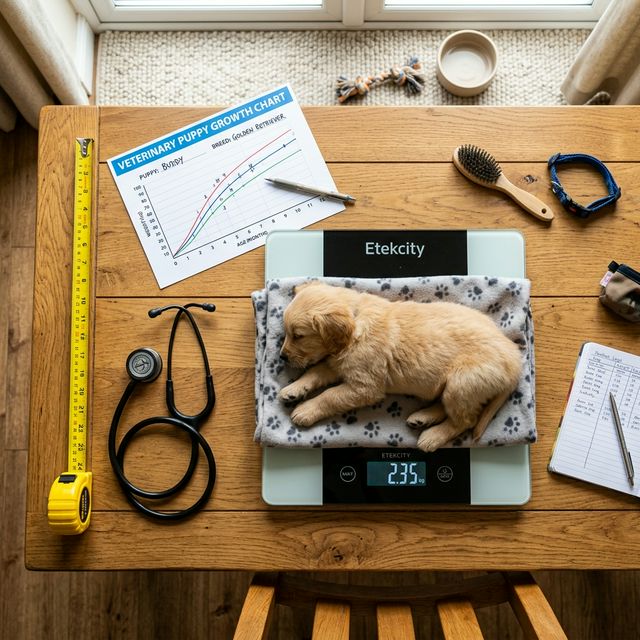
Whether you brought home a purebred Golden Retriever or a complete mystery mutt from the local shelter, every single owner wants to know the same thing: Just how big is this dog going to get?
While no calculation is perfect until the dog stops growing, veterinary science has provided us with highly accurate methods to estimate adult size. Here are the 7 most reliable ways to tell how big your puppy will be.
💡 Key Takeaway (Bottom Line)
The 7 most reliable ways to predict a puppy’s adult size are: The 16-week multiplier, sigmoidal biological calculators, evaluating parental genetics, the 12-week small breed formula, tracking velocity of growth, clinical DNA swab panels, and the 6-month growth plate plateau.
1. Use the 16-Week Mathematical Multiplier
This is the most famous back-of-the-napkin veterinary calculation. At 16 weeks (exactly 4 months) of age, a puppy hits a critical biological milestone. For medium and large breeds (dogs that will mature between 30 and 80 lbs), doubling their 16-week weight provides a surprisingly accurate estimate of their final adult weight. At exactly 16 weeks, medium dogs are essentially at 50% of their final skeletal mass.
2. The Sigmoidal Growth Curve Calculator
Instead of basic linear multiplication, biological science uses calculus. By plotting your puppy’s exact chronological age in weeks alongside their current weight, clinical algorithms can chart them against standardized sigmoidal (S-shaped) curve matrices established by the AVMA. This is the most accurate real-time method available. You can run these numbers instantly on our Veterinary Puppy Weight Predictor.
3. Examine the Parents’ Genetics (If Known)
Because growth is a polygenic trait, a puppy’s size is heavily influenced by the genetics of the Dam and Sire. A standard veterinary rule of thumb is to take the mother’s weight, add the father’s weight, and divide by two.
- Veterinary Insight: A puppy’s birth weight is heavily dictated by the mother’s uterine size, but their final adult height and skeletal density are strongly influenced by the father’s genetics. This is extremely important to monitor when evaluating F1 hybrids like Labradoodles.
4. The 12-Week Small Breed Formula
If you have a Toy or Small breed puppy (like a Chihuahua, Pomeranian, or Yorkie), the 16-week rule will catastrophically fail you. Small breeds grow much faster and finish months earlier. For toy breeds, the standard mathematical formula is to take their weight at 12 weeks (3 months), double it, and add one pound.
5. Calculate Velocity of Growth (Weight Gain per Week)
If you weigh your puppy every single week from 8 weeks to 16 weeks, you can establish their “Velocity of Growth.” Large breed dogs typically put on 2 to 2.5 pounds per week during this rapid-growth phase, while medium breeds put on about 1 pound per week. If their velocity is incredibly steep (e.g. consistently gaining 3 lbs a week), prepare for a very large giant-breed adult and beware of rapid-growth joint dysplasia.
6. Conduct a Commercial Canine DNA Panel
If your puppy is a rescue and you have absolutely no idea what blend of breeds they are, mapping their growth curve can be incredibly difficult. A commercial canine DNA panel (like Embark or Wisdom Panel) will literally swab your dog’s saliva and clinically look for specific genetic markers, such as the IGF1 and IGFR1 gene variants, which control skeletal growth boundaries. They will provide a genetically-backed weight estimate often within a 5-pound margin of error.
7. Wait for the 6-Month Plateau Benchmark
By exactly 6 months of age, almost all canine epiphyseal (growth) plates begin preparing to fuse.
- Toy breeds are essentially 100% fully grown.
- Medium breeds are at 75% of their adult weight.
- Large breeds are at 60% of their adult weight.
By checking their height at the shoulders at 6 months, you can generally safely assume they will only gain another 1 to 2 inches of height before stopping permanently. Their vertical frame is officially set, though large dogs will continue to add dense muscle mass for another 12 to 18 months!